

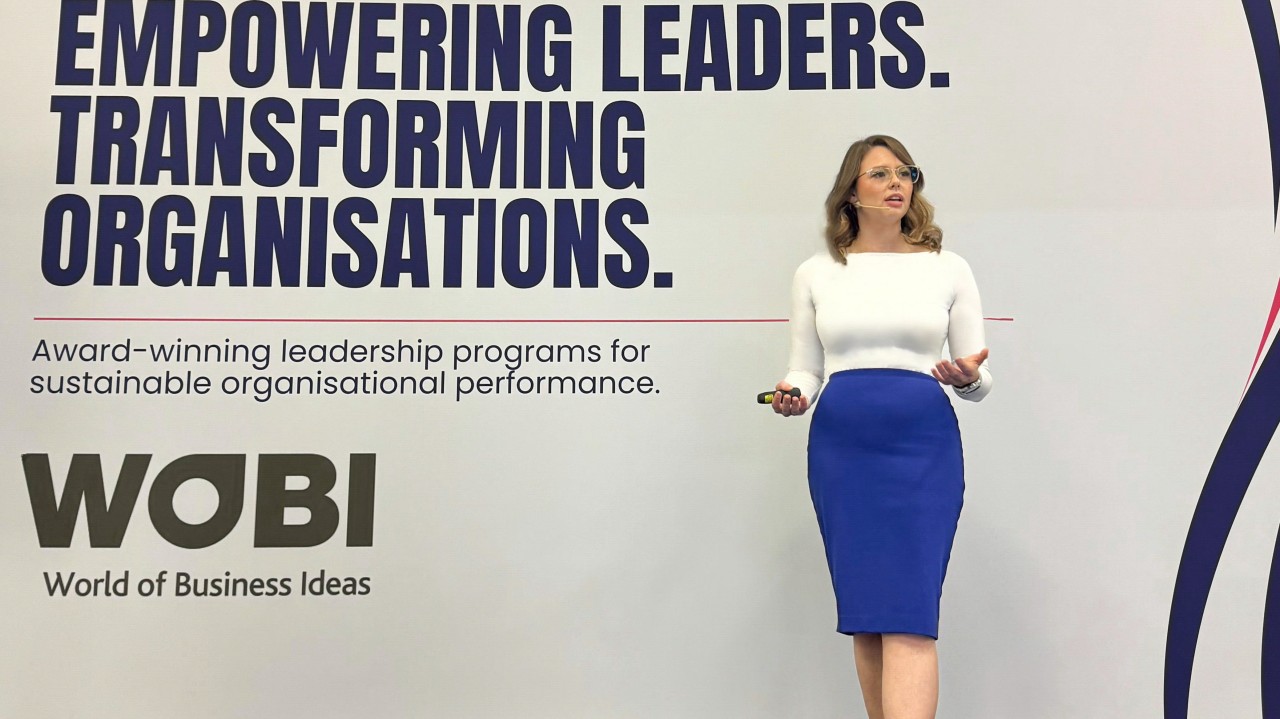
The World of Business Ideas (WOBI) Sydney brought together some of the world's most influential thinkers on leadership, innovation, AI, and organisational transformation. Across both the main stage and the Dynamic Leadership Programs Australia (DLPA) breakout sessions, a clear pattern emerged: whether the discussion focused on psychological safety, intelligent failure, high-performance mindsets, or the rise of AI, every speaker pointed toward the same shift, just from different angles.
Successful Leadership is Human-Centred
While organisations race ahead with new AI tools and systems, our people are still working with a biological operating system wired for certainty, predictability, and control. This gap, between technological speed and human adaptation, is now the real leadership challenge.
Across the event, each speaker reinforced this reality from their own perspective. Amy Edmondson spoke about psychological safety and intelligent failure, creating environments where low-task mistakes become learning data rather than sources of shame. Michael Phelps emphasised visualisation, resilience, and overcoming setbacks. Success isn't about avoiding challenges; it's about developing the psychological resilience to navigate them. Guy Kawasaki brought a different angle, emphasising AI as a creative accelerator, a force multiplier for thinking, experimenting, and building. His message centred on momentum, highlighting that leaders don't need perfection; they need progress, and AI accelerates that progress. Renée Richardson Gosline emphasised the human factor and the emotional dimensions of customer experience. This point deeply resonated as it echoes Kahneman's work in Thinking, Fast and Slow (a book I highly recommend). People remember how you make them feel more than the information you give them.
While each speaker delivered a powerful, unique message that stood alone, together, they all revealed a deeper pattern, a common theme:
The Human Factor Is Your Competitive Advantage
AI is transforming business at an extraordinary speed. Yet most change efforts still fail, with some estimates as high as 84%. Organisations are racing to adopt AI, but the missing piece remains the same: the human response to disruption.
As AI evolves, it will continue to expose data governance risk, challenge expertise, reveal capability gaps, and accelerate workflow change, triggering neurological responses around control, uncertainty, and threat. All of which exacerbate resistance to change. Even the best strategy will falter if we ignore the behavioural and psychological side of change. Leaders who understand both the behavioural and technological sides of disruption are better positioned to guide teams through this turbulence.
This is the purpose of the OPEN model: a four-step, evidence-based process that reflects the dual operating systems (people and tech) that leaders navigating AI transformation must work with.
O.P.E.N. (Human-Centred AI Transformation)
In late 2022, just before ChatGPT entered the public consciousness, I decided to step away from my business to take an education-focused academic role at UNSW Business School. Since then, my work has been at the intersection of business innovation, AI transformation, and human behaviour.
Taking this role was in many ways a licence to experiment, as I was effectively paid to learn, research, and develop AI tools. I designed, piloted, and refined experiments in human-centred AI adoption. Lecture halls, research groups, teaching teams, professional communities, and even book club groups became living laboratories for this work. After facilitating dozens of workshops and speaking at national and international academic conferences, WOBI Sydney 2025 marked my official return to the corporate sector and the introduction to this industry-driven iteration of the OPEN model.
This evolved framework provides leaders with a clear, evidence-based pathway for aligning technology with human behaviour to support teams through complex transformation. Traditional models like ADKAR and Kotter still offer a solid foundation, but they were never designed for the cognitive load, prediction errors, and threat responses triggered by AI disruption. OPEN complements these frameworks by integrating behavioural science and AI capability-building, giving leaders a practical, human-centred sequence for navigating the psychological demands of change.
Observe & Orient
Awareness precedes adaptation.
Human: Our brains are hardwired for predictability, patterns, and habits. During times of uncertainty, the brain’s threat system narrows attention and pulls us toward old patterns. Listen deeply. Understand resistance. Build trust and normalise intelligent failure.
AI: Before piloting anything, orient around privacy, governance, and data exposure. Next, identify friction points, repetitive tasks, and workflow gaps where AI can reduce cognitive load and improve clarity. Think of this as identifying pressure points where minor adjustments can relieve larger mental strain.
Purpose & Prompt
Purpose is the 'why.' Prompting is the 'how.'
Human: When people understand the 'why' behind a change, the prefrontal cortex (your strategic thinking centre) engages. Prompting and asking better questions further engages this deliberate thinking system. Together, purpose and prompting can interrupt the threat response and redirect neural energy toward problem-solving and innovation.
AI: Purpose will help set guardrails for what AI has access to, how data will be protected, and where human oversight remains essential to ensure responsible and secure implementation. Prompt effectively to automate processes, refine agents, and demonstrate how AI supports meaningful work. Clear purpose is the treatment plan; well-designed prompts or tools are the targeted exercises.
Experiment & Evaluate
Transformation is built on intelligent failure, not ROI.
Human: Learning requires prediction error (i.e., a mismatch between what the brain expects and what actually happens), and prediction error is the catalyst for neuroplasticity (i.e., the brain's ability to rewire itself and update how it thinks). Learning occurs when:
Expected Outcome ≠ Actual Outcome
Both AI and the human brain learn through prediction error. It’s time leaders leverage this parallel.
AI: Treat AI like a bright intern whose work you evaluate. Provide clear instructions and data, offer guidance, and run small experiments. Understand your data sources, check for biases and errors, and evaluate outputs. Learn what works before scaling broadly. Prioritise progress and learning over perfect outputs and immediate revenue.
Navigate & Nurture
“Culture eats strategy for breakfast” – Peter Drucker
Human: AI is evolving faster than the human nervous system can naturally adapt. It takes 30–90 days for the brain to develop a new automatic response or habit, depending on complexity and emotional load. Like building physical strength, neural change requires repetition, recovery, and time. Build habits gradually, provide ongoing support, and nurture confidence alongside capability. Aim to create a psychologically safe culture where mistakes and failures become catalysts for learning and growth. Culture is built through what we reinforce, not what we announce.
AI: Embed tools into daily workflow. Promote visibility around experiments. Share successes and failures transparently and openly. Create organisational “muscle memory” by making new behaviours easy, repeatable, and visible.
Adapt your roadmap as the technology evolves. Design an agile strategic plan that evolves alongside technology. Strategically plan for continuous disruption and transformation.
The pace of change requires resilience; the complexity of change requires learning.
What This Means for 2026
We must move beyond the simple question, “How do we implement AI?” and start asking:
“How do we lead our people to evolve alongside technology?”
The organisations that thrive will be those that invest in psychological safety, intelligent failure, resilience, and human-centred AI capability development. Technology alone won’t transform your business; your people will.
As we traverse the AI frontier, let’s keep the human factor at the centre. Leaders and organisations investing in their people and cultures now will set the pace for the next era. If you're also navigating this shift, I genuinely welcome the chance to connect and share what we are learning.
In 2026, this work will expand globally. Partnering with industry and academic researchers across Australia, Europe, and the US, we are conducting cross-cultural, industry-based studies to validate and advance the OPEN model. As we enter this next phase, expressions of interest will open early next year for organisations and leaders wanting to help shape and advance this work. If this resonates, reach out, and let’s start the conversation now.