

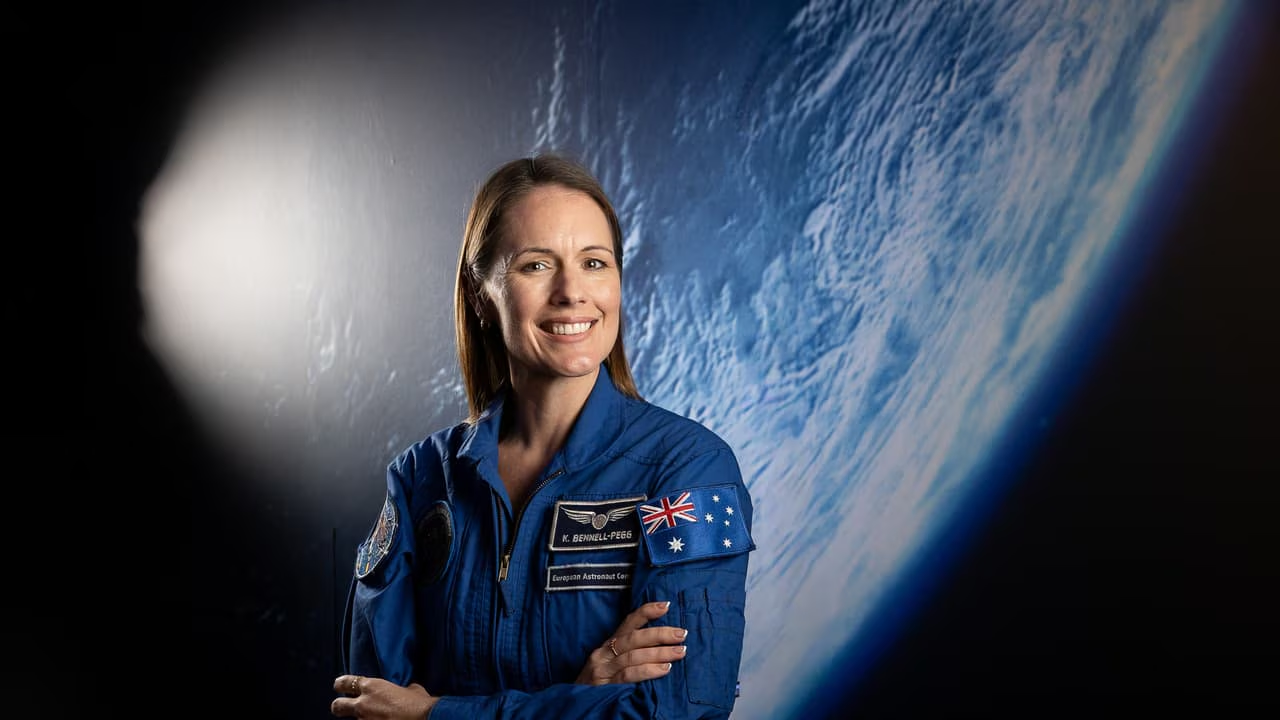
Recently, I had an incredible opportunity to hear Katherine Bennell-Pegg speak.
Australia's first professionally qualified astronaut and the 2026 Australian of the Year, Bennell-Pegg has undergone training most of us will never experience. She was one of just 25 people, from more than 22,500 applicants, to pass all stages of the European Space Agency's astronaut selection, and trained across medicine, engineering, survival, languages, physical conditioning and the technical capabilities required to operate in space.
I went excited to hear about space. I left thinking about human intelligence.
It is very easy to become mesmerized by the extensive technical training required to become an astronaut, but what struck me was not the breadth of what they are expected to learn. It was how deliberately the training develops the person doing the work.
Bennell-Pegg spoke about three ways to fail astronaut training. One was medical. The second was failing to put in the effort. The third was not being a team player. As she put it, “you have to uplift each other and pass as a team.” I expected a high failure rate in one of the most technically demanding professions in the world, but I didn't expect the reasons for failure to be so deeply human.
While the room was understandably fascinated by the technology, technical training, and whether aliens exist, I found myself more fascinated by how crucial human behavior and learning were to their training. They must complete dedicated Human Behavior and Performance training, including survival exercises, emergency scenarios, and environments designed to test how they work together under pressure. One comment she made that really stuck with me was about self-care.
“If you burn yourself out, you're marked down and seen as less of an astronaut because it's been proven over time to cause toxicity in space.”
Self-care and the ability to manage stress are assessed as part of their performance. Essentially, if you continually burn yourself out, you have less capacity available when something genuinely goes wrong. As Katherine put it, “That doesn't mean you don't work hard. It means you work hard when you need to.”
The more she spoke, the less astronaut training sounded like a program designed simply to build technical expertise, and the more it sounded like one designed to develop people capable of operating in complexity.
That distinction matters.
High performance in complex environments requires more than knowledge and expertise. It requires the ability to work across different domains, hold competing perspectives, recognize interdependencies, adapt when conditions change, and still exercise judgment when the answer is not obvious.
Research offers different ways to understand these capabilities. Systems thinking helps us see relationships and interdependencies. Cognitive flexibility helps us adapt as information and conditions change. Metacognition allows us to monitor and adjust our own thinking.
Different concepts, but all pointing to something broader: our ability to think beyond the immediate task in front of us. That capability is becoming increasingly important as AI changes the work humans are required to do.
AI is getting very good at cognitive tasks that once consumed significant amounts of our time. It can retrieve information, summarize it, generate options, draft, analyze, and increasingly complete sequences of work on our behalf.
That doesn't make human intelligence less important. It changes where its value sits.
As more routine cognitive work becomes easier to delegate, more of our value moves toward framing the problem, understanding the system, evaluating competing possibilities, anticipating consequences and deciding where human judgment is required. The more capable the technology becomes, the more important the quality of the thinking around it becomes.
But here is the problem.
The same technology increasing the value of sophisticated human thinking is also making it easier to outsource the very processes through which that thinking develops.
A growing body of research is pointing in the same direction. Microsoft's 2025 study of 319 knowledge workers found that greater confidence in generative AI was associated with less self-reported critical thinking (Lee et al., 2025). Other experimental studies have linked greater reliance on AI with shallower learning, weaker retention and poorer independent performance once the technology is removed (Bastani et al., 2025; Melumad & Yun, 2025; Kreijkes et al., 2026).
In some cases, people performed better with AI in the moment but understood less, remembered less or struggled more when they had to work without it.
That gap between performance and capability is important.
Learning still requires us to engage cognitively and metacognitively with information: to retrieve what we know, generate ideas, wrestle with problems, notice what we do not understand and reflect on our own reasoning.
We have known for years that information we generate ourselves is remembered better than information we simply read, and that appropriately designed struggle can strengthen learning and transfer (Bertsch et al., 2007; Sinha & Kapur, 2021).
When AI removes too much of that work, it can also remove some of the processes through which judgement and capability are developed. That does not make this an argument for using less AI. It makes it an argument for using AI with more intention.
The evidence also shows that when AI is designed to enhance thinking rather than replace it, the outcomes can look very different.
In the same research where unrestricted AI use harmed later learning, versions designed to guide people through problems rather than simply provide the answer largely avoided that effect (Bastani et al., 2025). A Harvard study found that students using a carefully designed AI tutor learned more in less time than students in an active-learning class (Kestin et al., 2025). Other research found that combining AI with active behaviors such as note-taking supported stronger comprehension and retention than relying on the AI alone (Kreijkes et al., 2026).
The issue is not simply whether we use AI. It is what we ask it to do for us, and what thinking we still choose to do ourselves. This is the challenge: knowing which cognitive effort to offload and which cognitive processes we still need to practice and develop.
We should offload work that frees us to engage in more complex thinking, without automatically offloading the cognitive effort through which that thinking develops. For organizations, this is a capability-development issue. For leaders, it is also a performance issue.
If AI changes how people think, learn, and build judgment, then how it is introduced into work will shape organizational capability over time. Think about a junior employee who once had to analyze the data, wrestle with different interpretations, draft a recommendation, and then defend the reasoning behind it. AI can now help with every one of those steps and probably produce a better first draft.
Yet, if it does too much of the thinking, where does that person learn to recognize when the answer is wrong? Where do they practice judgment?
This is not an argument for making people do unnecessary work. It is a question about how we design or redesign work. Which tasks should AI remove? Which should it augment? And where do people still need opportunities to think, test, make mistakes, receive feedback, and build judgment?
This is why I kept coming back to Katherine's story.
Astronaut training does not assume that because someone was capable enough to be selected, the human capabilities required for the job will simply take care of themselves. They are trained deliberately.
They practice working together under pressure. They are put into unfamiliar environments. They learn when to push and when recovery matters. They learn that being technically brilliant is not enough if you cannot “uplift each other and pass as a team.”
This was not simply technical training. It was deliberate human development.
Astronauts cannot learn the answer to every possible problem they might encounter. They must develop the capacity to respond when there is no rehearsed answer, when the situation changes, when the system behaves unexpectedly, when another person sees something differently, or when something goes wrong.
Those capabilities are not treated as optional extras. They are part of what makes someone capable of doing the job well.
I believe that is an important lesson for business.
We are investing extraordinary amounts of resources and attention in building, buying, and integrating increasingly capable AI. We need to become equally deliberate about developing the humans who will work alongside it. That means looking beyond adoption and productivity. If AI changes the work people practice every day, it also changes the opportunities they have to develop judgment, expertise, and the capacity to think for themselves.
Katherine's story reminded me that exceptional human capability is not accidental. Technical knowledge matters, but so do effort, teamwork, adaptability, self-regulation, and the ability to perform when conditions change. None of those capabilities are simply assumed. They are developed.
And perhaps that is the bigger opportunity AI gives us.
Used well, it can remove cognitive work that no longer deserves our attention and create more space for judgment, learning, and more sophisticated thinking. But only if we are deliberate about what we remove and what we continue to develop.
For leaders, the question is no longer simply what AI can do for business. It is how AI use is shaping the way people think, learn and exercise judgment. As technology becomes more capable, human development cannot sit somewhere downstream as a people initiative. It becomes part of how we design work, build capability, and lead the organization.
The opportunity is to develop both at the same time: increasingly capable technology and increasingly capable humans.
Technology expands possibilities. Human judgment sets direction.
References
Bastani, H., Bastani, O., Sungu, A., Ge, H., Kabakcı, Ö., & Mariman, R. (2025). Generative AI without guardrails can harm learning: Evidence from high school mathematics. *Proceedings of the National Academy of Sciences, 122*(26), e2422633122. https://doi.org/10.1073/pnas.2422633122
Bertsch, S., Pesta, B. J., Wiscott, R., & McDaniel, M. A. (2007). The generation effect: A meta-analytic review. *Memory & Cognition, 35*(2), 201–210. https://doi.org/10.3758/BF03193441
Kestin, G., Miller, K., Klales, A., Milbourne, T., & Ponti, G. (2025). AI tutoring outperforms in-class active learning: An RCT introducing a novel research-based design in an authentic educational setting. *Scientific Reports, 15*, 17458. https://doi.org/10.1038/s41598-025-97652-6
Kreijkes, P., Kewenig, V., Kuvalja, M., Lee, M., Hofman, J. M., Vitello, S., Sellen, A., Rintel, S., Goldstein, D. G., Rothschild, D. M., Tankelevitch, L., & Oates, T. (2026). Effects of LLM use and note-taking on reading comprehension and memory: A randomised experiment in secondary schools. *Computers & Education, 243*, 105514. https://doi.org/10.1016/j.compedu.2025.105514
Lee, H.-P., Sarkar, A., Tankelevitch, L., Drosos, I., Rintel, S., Banks, R., & Wilson, N. (2025). The impact of generative AI on critical thinking: Self-reported reductions in cognitive effort and confidence effects from a survey of knowledge workers. *Proceedings of the 2025 CHI Conference on Human Factors in Computing Systems*, Article 1121, 1–22. https://doi.org/10.1145/3706598.3713778
Melumad, S., & Yun, J. H. (2025). Experimental evidence of the effects of large language models versus web search on depth of learning. *PNAS Nexus, 4*(10), pgaf316. https://doi.org/10.1093/pnasnexus/pgaf316
Sinha, T., & Kapur, M. (2021). When problem solving followed by instruction works: Evidence for productive failure. *Review of Educational Research, 91*(5), 761–798. https://doi.org/10.3102/00346543211019105